Every enterprise leader I talk to knows they have technical debt. What they often struggle with is communicating the real cost to the board in a way that justifies action. You can't just say "our systems are old." You need numbers. You need to show how that **technical debt assessment** translates into lost revenue, increased risk, and missed opportunities. Without that, remediation efforts get deprioritized every time.
Technical debt assessment is the process of identifying, categorizing, and quantifying the various forms of technical debt within an organization's systems. A thorough assessment provides a clear understanding of the risks and costs associated with that debt, enabling informed decisions about remediation.

TL;DR: Quantifying technical debt requires translating engineering realities into business-relevant metrics like increased operational costs, slower time-to-market, and heightened security risks. A detailed technical debt assessment provides the data needed to justify remediation efforts to the board. Prioritizing high-impact, low-effort remediation projects first delivers quick wins and builds momentum for larger modernization initiatives.
Translate Engineering Problems into Business Costs
The key to getting board-level buy-in for technical debt remediation is to frame the problem in terms they understand: money. I've seen too many presentations filled with jargon that goes straight over their heads. Instead of talking about code quality or architectural patterns, focus on the direct impact on the bottom line. Start by identifying the specific ways technical debt manifests in your organization and then calculate the associated costs. This could include increased maintenance expenses, higher operational risks, and decreased development velocity. For example,
IBM notes that technical debt can lead to increased costs and lost productivity. The more clearly you can connect technical issues to financial outcomes, the more likely you are to get the resources you need to address them.
Quantify the Impact of Technical Debt Across Key Areas
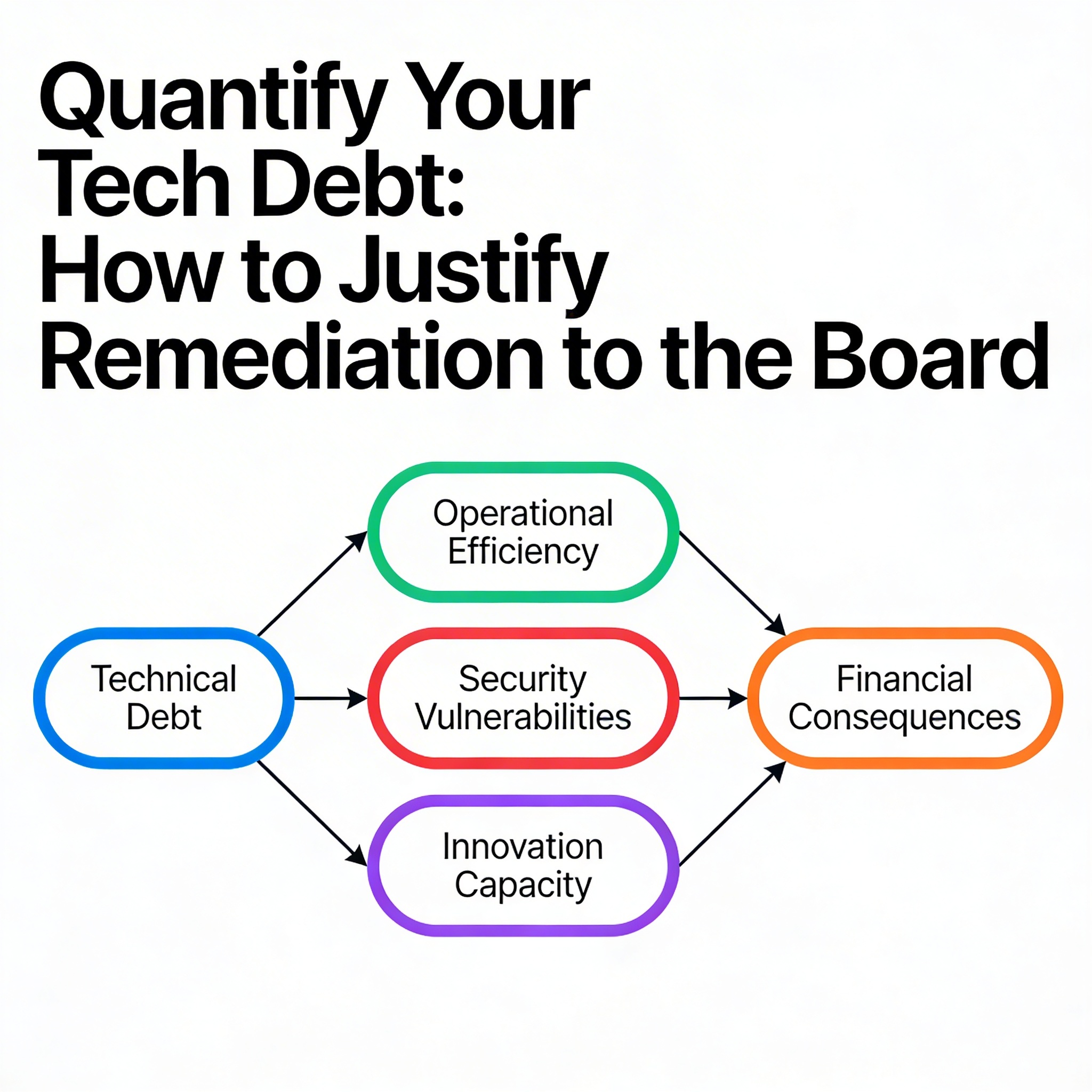
To effectively quantify technical debt, you need to assess its impact across several key areas, translating technical issues into tangible business consequences. The most common areas I focus on are operational efficiency, security vulnerabilities, and innovation capacity. In terms of operational efficiency, consider the additional time and resources required to maintain outdated systems. Security vulnerabilities can be quantified by estimating the potential financial impact of a data breach. Finally, assess how technical debt limits your ability to innovate and respond to market changes. For instance, if it takes your team twice as long to release new features compared to competitors, what is the cost of that delay in terms of lost market share?
The Tech Debt Self-Assessment Workbookprovides a structured approach to identify and assess these areas effectively.
Use a Scoring System to Prioritize Remediation Efforts
Not all technical debt is created equal. Some issues have a greater impact on the business than others, and some are easier to fix. That's why I recommend using a scoring system to prioritize remediation efforts. Assign scores based on both the impact (e.g., financial loss, customer churn) and the effort required to fix the issue (e.g., time, resources). Then, focus on the high-impact, low-effort items first. This approach allows you to achieve quick wins that demonstrate the value of remediation and build momentum for tackling more complex problems. I learned this the hard way when I pushed for a massive architectural overhaul before addressing smaller, more pressing issues. The project stalled, and we lost credibility with the board. Start small, show results and build from there.
Ardoq highlights the importance of prioritization when managing technical debt.
Build a Business Case with Clear ROI Projections
Once you've quantified the impact of technical debt and prioritized remediation efforts, it's time to build a business case that clearly demonstrates the return on investment (ROI) of your proposed solutions. This is not just about fixing code; it's about improving business outcomes. Your business case should include specific, measurable, achievable, relevant, and time-bound (SMART) goals, such as reducing operational costs by 20% within six months or increasing deployment frequency by 50% within a year. Be prepared to present a range of scenarios, including the cost of inaction. What will happen if you don't address the technical debt? Will you lose customers? Will you be unable to compete? The more compelling your ROI projections, the more likely you are to secure the necessary funding. The way we approach this in our
Control engagementsis to fix the most painful bottleneck first, before designing the long-term roadmap.
| Metric | Current State | Target State | Projected Improvement |
|---|---|---|---|
| Operational Costs | $500,000/month | $400,000/month | 20% reduction |
| Deployment Frequency | 1/month | 2/month | 100% increase |
| Customer Churn | 5%/month | 3%/month | 40% reduction |
| Security Incidents | 3/year | 1/year | 66% reduction |
Looking to accelerate your engineering delivery? Wednesday Solutions our services service helps engineering teams ship faster and more reliably.
Beyond simply identifying technical debt, a robust assessment should also categorize it based on its impact and urgency. A common framework involves classifying debt into quadrants: critical, high, medium, and low. Critical debt represents issues that are actively causing system outages, data corruption, or security vulnerabilities. These require immediate attention and should be prioritized above all else. High-impact debt encompasses problems that significantly hinder development velocity, increase operational costs, or create substantial business risk. Medium-impact debt might include inefficiencies that slow down specific processes or features, while low-impact debt represents minor code smells or deviations from best practices that have minimal immediate consequences. This categorization allows for a more strategic approach to remediation, ensuring that the most pressing issues are addressed first and that resources are allocated effectively.
Another crucial aspect of a comprehensive technical debt assessment is the creation of a remediation roadmap. This roadmap should outline the specific steps required to address each identified instance of debt, along with estimated timelines, resource requirements, and potential risks. The roadmap should also consider the interdependencies between different debt items, as addressing one issue might inadvertently resolve or exacerbate others. Furthermore, it's essential to factor in ongoing development activities and business priorities when planning remediation efforts. A well-defined roadmap will not only provide a clear path forward for addressing technical debt but also enable better communication and alignment between technical teams, business stakeholders, and management. It should be a living document, regularly reviewed and updated to reflect changing priorities and emerging challenges.
Finally, don't underestimate the importance of documenting your technical debt assessment process and findings. This documentation serves as a valuable resource for future reference, enabling you to track progress, measure the effectiveness of remediation efforts, and identify recurring patterns of debt accumulation. It should include a detailed inventory of all identified debt items, along with their categorization, impact assessments, remediation plans, and associated costs. The documentation should also capture the rationale behind prioritization decisions and any trade-offs that were made. By maintaining a comprehensive record of your technical debt assessment, you can create a culture of transparency and accountability, fostering a more proactive approach to managing technical debt over the long term. This historical data can also be invaluable for training new team members and ensuring that knowledge about technical debt is not lost when individuals leave the organization.
Real-world example: Reducing Cloud Costs for a Fintech Company
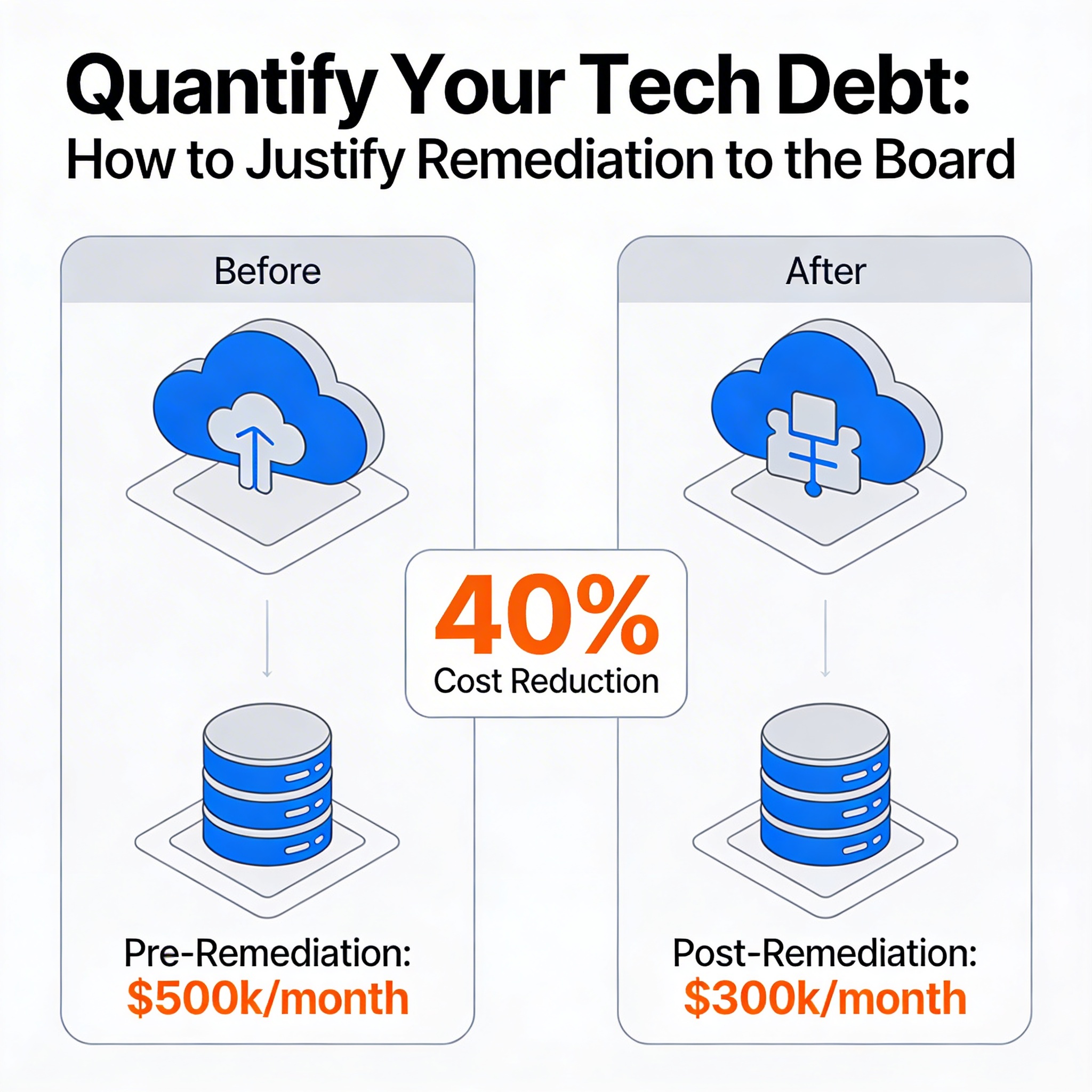
I worked with a Series B fintech company that was experiencing runaway cloud costs. Their infrastructure had grown organically over several years, resulting in a tangled mess of underutilized resources, duplicated services, and inefficient configurations. As a result, they were spending over $300,000 per month on cloud infrastructure, with no clear understanding of where the money was going. We started with a comprehensive
technical debt assessment, identifying the areas of greatest waste and inefficiency. This included rightsizing instances, eliminating unused services, and optimizing database queries. We then developed a remediation plan that prioritized the easiest and most impactful changes. For example, we consolidated several databases into a single, more efficient instance, and we automated the process of scaling resources up and down based on demand. Within three months, we had reduced their cloud costs by 40%, saving them over $120,000 per month. This not only improved their bottom line but also freed up resources to invest in new product development.
The leaders who successfully get resources to address technical debt are the ones who do the hard work of translating technical realities into business language. If you're facing resistance from your board, it's time to step back and assess how you're communicating the problem. Are you speaking their language? Are you quantifying the impact? Are you presenting a clear ROI?
If you're struggling to make the case for technical debt remediation, the first step is to get a clear picture of the problem. That's why at Wednesday, we work with enterprises to conduct thorough assessments, quantify the business impact, and build compelling business cases , a process that often starts with our Control service.
Quantify Your Technical Debt and Reduce Risk
Understand the true cost of your technical debt and secure budget for remediation efforts. Get clear metrics and a compelling ROI to present to your board.
FAQs
How much technical debt is too much when launching an MVP?
It's a balancing act. Early on, some technical debt is acceptable to achieve product-market fit quickly. However, if it significantly slows down development, impacts user experience, or creates security vulnerabilities, it's time to reassess. Prioritize paying down debt that blocks learning or risks your runway.
What metrics should I track in a technical debt assessment dashboard?
Focus on metrics that translate engineering realities into business terms. Track operational costs, development velocity, security vulnerabilities, and customer impact. For example, measure the time it takes to deploy new features, the number of critical bugs, or the cost of maintaining legacy systems. This helps justify remediation efforts.
How do I explain the need for technical debt remediation to non-technical investors?
Frame it in terms of financial impact. Explain how technical debt increases operational costs, slows down development, and creates security risks. Provide concrete examples, like lost revenue due to system downtime or increased development time due to inefficient code. Show how addressing technical debt improves the bottom line.
Last updated: