
Your board signed off on the budget, a glossy roadmap promised mainframe freedom, and the cloud vendor brought a slide deck full of arrows and upward graphs. Yet the core workloads are still humming away on the mainframe, the migration program is “paused for reassessment,” and everyone is trying not to use the word failure. According to one industry analysis, half of cloud transformations are described as “abject failures,” and more than two-thirds of organizations investing strategically in cloud see fewer than one-third actually realize their ambitions. That gap between intention and reality is exactly where stalled mainframe-to-cloud programs live.
When a migration falters, it rarely comes down to one bad call or one flawed tool. Patterns repeat across industries: big-bang rewrites that never land, under-estimated skills gaps, tangled integration work, and cloud strategies that ignore the operating reality of large, regulated enterprises. The good news is that most “failed” programs are not dead; they are stuck. And with a clear diagnosis and a pragmatic rescue plan, a stalled initiative can still become a sustainable modernization story.
Why so many mainframe-to-cloud projects stall out
Many modernization programs are built on a deceptively simple idea: just rewrite the old stuff. The assumption is that a clean, cloud-native replacement will be faster, cheaper, and easier to maintain than the mainframe estate. Reality is harsher. One industry report found that nine in 10 rewrite projects do not succeed on their initial attempt, with mainframe skills gaps, complex integration strategies, and inadequate tools frequently blamed. That is not a minor margin of error; it is a structural warning about how these programs are designed.
Under pressure from boards and regulators, organizations compress multi-year modernization into aggressive roadmaps. Dependencies between monolithic mainframe applications are glossed over. Testing and data migration are under-scoped. Teams are stretched between “keeping the lights on” and building the new world. What emerges is a fragile hybrid of old and new, where every small change threatens ripple effects across payments, customer records, reporting, and compliance systems. When the first serious incident hits, confidence evaporates and the program is quietly “re-evaluated.”
Reason 1: You treated modernization as a big-bang rewrite
Rewriting core mainframe workloads from scratch can feel emotionally satisfying. It promises a clean slate, no legacy baggage, and a sense of having finally “paid down” decades of technical debt. Yet this is exactly the scenario in which those nine-in-10 failure rates appear. A full rewrite assumes requirements are fully knowable up front, that the business will not shift during the project, and that every behavioral nuance of the legacy system is understood and documented. Those assumptions are rarely true.
Big-bang rewrites also remove the safety net of gradual learning. Teams discover missing business rules, corner-case transaction flows, and performance edge cases only when customers are already on the new platform. When it becomes clear that the new system does not behave quite like the old one, rollback options are limited and extremely painful. The more critical the workload-payments, risk, trading, claims, reservations-the less tolerance there is for mismatches or extended downtime.
By contrast, successful programs treat modernization as a series of controlled experiments rather than a single binary switch. They favor techniques like incremental refactoring, strangler patterns, and workload carving based on stable business domains. The destination may still be a cloud-native architecture, but the journey is designed for reversibility, observability, and intermediate value, instead of a single dramatic cutover date that everyone dreads.
Reason 2: Skills gaps and integration complexity killed momentum
Most enterprises underestimate how much specialized knowledge sits inside mainframe teams. It is not just COBOL or JCL syntax; it is decades of informal understanding about batch windows, data lineage, backout procedures, and the quirks of upstream and downstream systems. That expertise is typically concentrated in a small group of people who are also responsible for day-to-day stability. Asking them to simultaneously design a cloud future and maintain a flawless present sets them up for burnout and delay.
.jpg)
The skills issue does not end with legacy experts. Cloud-native teams often lack deep understanding of mainframe behavior, especially around transaction integrity, throughput, and operational discipline. When these groups finally sit down together, they run into the “translation tax”: hours spent converting concepts and constraints from one world to the other. One industry survey highlighted a potential bridge across this divide: 80% of respondents said that if applications written in legacy languages could be placed into a modern development environment, their organization’s newer generation of developers could learn to manage them. That is a strong argument for approaches that preserve existing code while opening it up to modern tooling and practices.
Integration complexity is the other silent killer. Mainframe applications seldom operate in isolation; they are tightly coupled to message queues, batch pipelines, partner interfaces, and regulatory reporting systems. When modernization focuses solely on application code and ignores those connections, hidden dependencies emerge late and expensively. Performance bottlenecks appear at the boundary between cloud and mainframe. Data consistency issues creep in when multiple systems of record are updated in different ways. The result is a landscape where neither side-the old or the new-feels stable enough to build on.
Reason 3: You chased cloud and AI without a clear operating model
Once a program is branded “cloud-first,” expectations skyrocket. Leadership expects agility, cost transparency, and rapid experimentation. Business lines start asking about generative AI, real-time personalization, and advanced analytics. Yet the underlying operating model-how teams are structured, how risk is managed, how changes are promoted to production-often remains built around mainframe-era assumptions. This mismatch creates friction and slows everything down.
Evidence of this disconnect shows up beyond the mainframe context. One analysis found that over two-thirds of organizations have made strategic investments in cloud, but fewer than one-third are actually realizing their ambitions from those investments. The technology is present; the outcomes are not. Cloud platforms are powerful, but they do not automatically fix organizational silos, governance bottlenecks, or under-funded change management.
The same pattern is emerging with generative AI. Many enterprises are excited about using AI to accelerate code modernization, automate documentation, or enhance observability. Yet a recent survey reported that 80% of respondents lacked a strategic framework for generative AI adoption. Dropping AI tools into a poorly defined modernization program risks amplifying confusion rather than solving it. Without guardrails, success metrics, and clear ownership, “AI-driven modernization” becomes another buzzword added to an already overloaded agenda.
The 3-step rescue plan for a stuck mainframe-to-cloud migration
A stalled migration can feel like a reputational crisis, but it is also an opportunity. By this stage, the organization has a clearer view of what is hard, which assumptions were wrong, and where the real risks lie. Instead of abandoning the effort or doubling down on the original plan, a better move is to treat the pause as a structured reset.
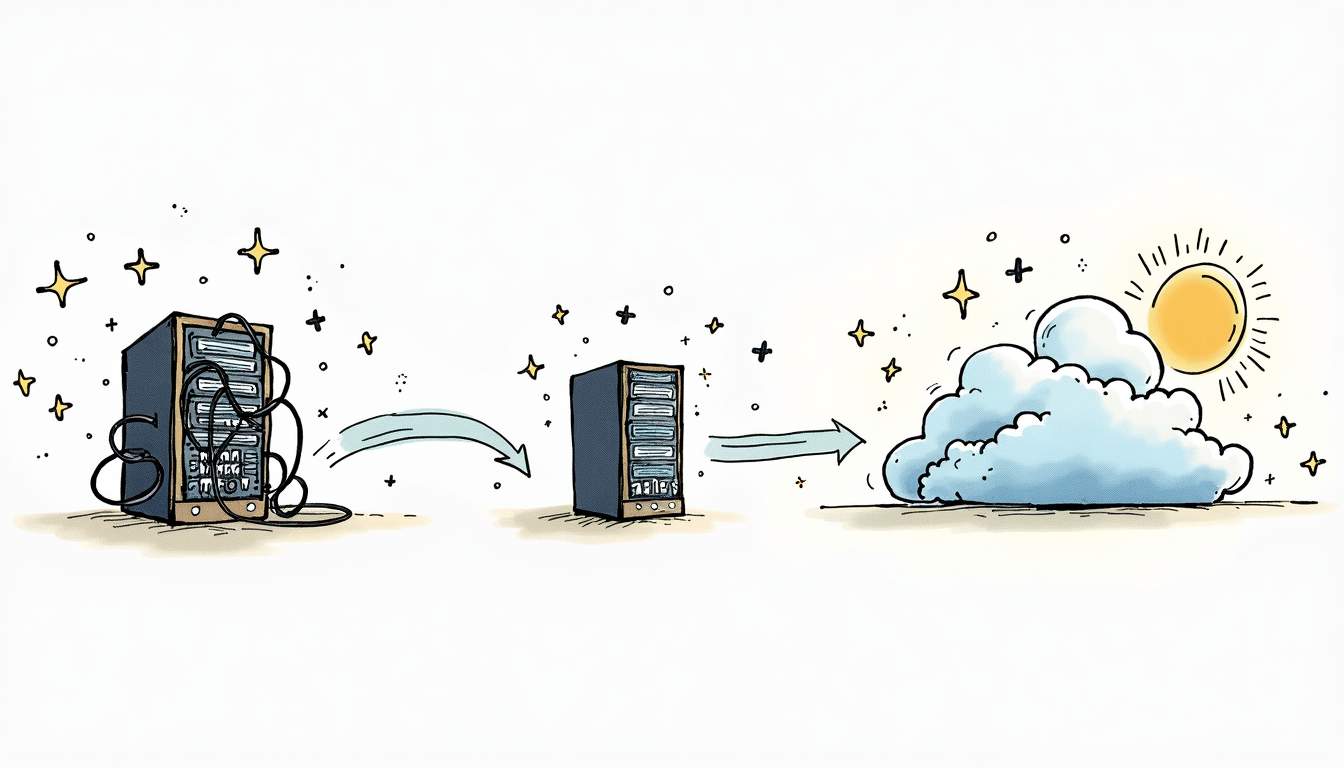
The rescue plan below is not a silver bullet, and it cannot erase sunk costs. It does, however, give leadership and delivery teams a path back to progress: diagnose reality without blame, redesign scope and architecture for incremental value, and rebuild delivery around cross-functional ownership rather than isolated silos. Each step is pragmatic and testable, so the program can regain trust through observable, small wins rather than grand promises.
Step 1: Diagnose the failure honestly and redraw the map
The first step is to replace narratives with facts. That means mapping exactly what exists today: which mainframe workloads are in production, which have partial cloud equivalents, what integrations are in place, and which business capabilities depend on each component. Many teams discover that they are closer to a hybrid operating model than they realized, with critical flows hopping between platforms in ways that were never formally designed.
Alongside the technical map, the program needs a candid assessment of how and why earlier decisions led to stalls. Were key mainframe experts unavailable? Were integration dependencies under-estimated? Did governance cycles stretch deployments to the point where momentum evaporated? This exercise works best when framed not as a hunt for culprits but as a way to identify systemic blockers. The aim is a shared, written understanding of where things stand, not another slide deck glossing over uncomfortable realities.
Step 2: Re-scope to business capabilities, not applications
With a clearer picture of the landscape, the next move is to change how work is sliced. Instead of migrating entire applications, focus on discrete business capabilities: statement generation, pricing rules, fraud checks, policy issuance, settlement calculations, and so on. Each capability can then be evaluated for criticality, regulatory constraints, data residency, performance profile, and change frequency. This framing makes it easier to decide which parts must stay on the mainframe longer, which can be rehosted, and which are good candidates for refactoring or replacement.
For each capability, establish a realistic end state-rehosted, wrapped, refactored, or rebuilt-and design a path that delivers intermediate value. This might mean exposing a mainframe capability as an API to unlock new channels, offloading specific analytical workloads to cloud, or moving non-critical batch processes first to build patterns and confidence. By tying each modernization slice to an observable business outcome, the program can demonstrate progress and earn the political capital needed for more ambitious moves.
Step 3: Build a hybrid delivery engine with shared ownership
Rescuing a stalled migration also requires a new way of working. The teams that build and run the mainframe and those that build on cloud cannot stay in separate worlds. A hybrid delivery engine brings them together around shared objectives and shared metrics. Cross-functional squads that include mainframe engineers, cloud architects, security, operations, and business product owners are better positioned to make trade-offs quickly and safely.
This is also the point to be intentional about tooling and environments. Where possible, give developers a consistent experience across platforms: common version control, automated testing, and unified observability. Remember the survey insight that a large majority of organizations believe newer developers can learn legacy applications if they are accessible in modern tools. Creating that bridge-through emulation environments, API gateways, or platform abstractions-turns the mainframe from a mysterious black box into another, well-governed component of a larger system. As confidence in the hybrid model grows, so does the organization’s ability to move workloads along the modernization spectrum without fear.
From stalled to steady: what success actually looks like
There is a temptation to measure success only when the mainframe is finally retired. That all-or-nothing mindset feeds risky rewrites and political drama. A healthier definition sees success as building a landscape where the mainframe is no longer a constraint: critical workloads can move when it makes sense, data can flow where it needs to, and teams are no longer paralyzed by fear of touching core systems. One industry report found that 90% of enterprises have already modernized mainframe workloads in response to the pandemic, with many targeting public cloud environments. Modernization is no longer optional or experimental; it is the norm.
For organizations currently stuck in transit, the path forward is neither denial nor wholesale reinvention. It is a disciplined reset: accept what the first attempt revealed, narrow the focus to well-defined capabilities, and build delivery structures that respect both mainframe realities and cloud possibilities. The board may still want a headline date for “leaving the mainframe,” but the real story of success will be told in quieter terms: fewer outages, faster changes, more resilient operations, and a technology estate that finally feels like an asset rather than a liability.
Breaking the Inertia: How to Take the First Step
Knowing how to rescue a project is different from having the capacity to do it. Internal teams are often too buried in firefighting to execute the first critical pivot. This is the specific operational gap addressed by Control.
Instead of restarting with another massive roadmap, Control deploys a specialized, AI-native team to attack a single, high-priority engineering blocker. Whether it’s untangling a specific mainframe dependency or refactoring a critical integration, we fix one hard problem at a fixed price—giving you the momentum to turn a "paused" program into a moving one.