
IT leaders say their organizations lose an average of $370 million every year because critical systems are stuck on outdated technology, according to analysis reported by ITPro. That is not just an IT problem. It is a drag on growth, a risk to operations, and a constant source of frustration for teams who know they could move faster if the technology would just keep up.
This is where legacy application modernization comes in. Done well, it turns brittle, expensive systems into flexible platforms for growth. Done badly, it burns budgets and trust. This guide breaks down what modernization actually means, why it matters, the main approaches, and how to build a strategy that works in the real world.
What is Legacy Application Modernization?
“Legacy” rarely means simply “old.” A legacy application is any system that is hard to change, expensive to run, risky to touch, or fundamentally out of alignment with how the business now needs to operate. It might still be mission-critical and generate most of the company’s revenue, yet rely on outdated architectures, aging infrastructure, or skills that are increasingly rare.

Legacy application modernization is the process of transforming these systems so they become easier to maintain, easier to integrate, and better suited to new business models. That transformation can involve changes to technology (such as moving from mainframes to cloud), changes to architecture (such as decomposing monoliths into services), and changes to how teams build and operate software.
Industry research from Red Hat notes that organizations modernizing are increasingly “focusing on the applications that run their business and the data that informs their business decisions, rather than customer-facing services.” This shift reflects a recognition that the real leverage comes from modernizing the operational backbone and data layer that power everything else, not only the interfaces users see on screen, as highlighted in the Red Hat application modernization report.
Why Modernization Matters: The Real Business Case
Legacy systems quietly tax almost every part of the organization. They limit how quickly new products can launch, how easily data can be shared, and how smoothly acquisitions can be integrated. They inflate operating costs through licenses, hardware, and specialized support. They increase risk when critical knowledge lives with a handful of near-retirement experts who know how to keep them running.
There is a strong upside to fixing this. A survey of digital transformation teams at more than 1,400 companies worldwide found that organizations whose digital transformation is considered complete achieved average annual revenue growth of 22.3% and profit margin growth of 9.9%, according to a study published with Google Cloud and Harvard Business Review Analytic Services on the business case for modernizing legacy applications. Modernization is a major contributor to that kind of performance because it enables faster experimentation, cleaner data, better automation, and more resilient operations.
Experts involved in that same research argue that modernizing legacy applications does more than tidy up technical debt. It “can not only remove these barriers but also enable the organization to go beyond iterative improvements in how IT is run to transform how the organization does business.” In practical terms, this is the difference between simply cutting costs in the data center and opening up entirely new revenue streams, business models, or partnerships that were previously impossible.
The Market Shift to Cloud-Native and Modern Platforms
Modernization is happening against a backdrop of rapid change in how software is built and run. By 2025, over 95% of new digital workloads are expected to be deployed on cloud-native platforms, according to analysis summarized by Softlabs Group. That shift signals a world where new capabilities, from AI to real-time personalization, increasingly assume elastic infrastructure, APIs, and modular architectures.
Vendors and service providers are investing accordingly. The global legacy application modernization market is projected to grow at a compound annual growth rate of 11.2% from 2025 to 2033, driven by cloud adoption and the need for more agile business processes, according to DataHorizzon Research. That level of growth indicates a sustained, long-term trend: modernization is becoming a standard part of enterprise strategy rather than a one-off clean-up project.
For technology and business leaders, this means the bar is rising. Competitors are progressively moving their core applications onto platforms that support continuous delivery, real-time analytics, and rapid scaling. Organizations that delay modernization risk not just operational inefficiency but structural disadvantage, because partners, vendors, and talent increasingly expect modern platforms and ways of working.
Common Legacy Application Modernization Challenges and Risks
Before drawing a roadmap, we must be brutally honest about the tax legacy systems levy on the organization. Technical debt works exactly like financial debt: small compromises made years ago are now compounding into unmanageable interest.
- Velocity Decay: Releases crawl because a single line change ripples across thousands of lines of tightly coupled code. Simple configuration updates that should take minutes trigger multi-week testing cycles.
- Integration Paralysis: Connecting modern SaaS tools becomes brittle or impossible, forcing teams to build elaborate, fragile workarounds.
- Escalating Risk: As components age out of support, security patches stop arriving. Compliance becomes a nightmare because data is scattered across custom silos with no clear lineage.
- The Talent Cliff: Recruitment becomes a struggle when roles require expertise in obsolete frameworks. This creates dangerous "key-person risk," where the entire platform hinges on the few engineers who still remember how the machine works.
Modernization Approaches to Legacy Application: From Quick Wins to Full Transformation
Not every legacy system needs the same level of change. Modernization spans a spectrum of approaches, each with different risk, cost, and payoff. At one end is “rehosting,” often called lift-and-shift, where applications are moved to modern infrastructure with minimal changes. This can reduce hardware and data center costs and provide a more stable platform, but does little to tackle deep architectural issues.
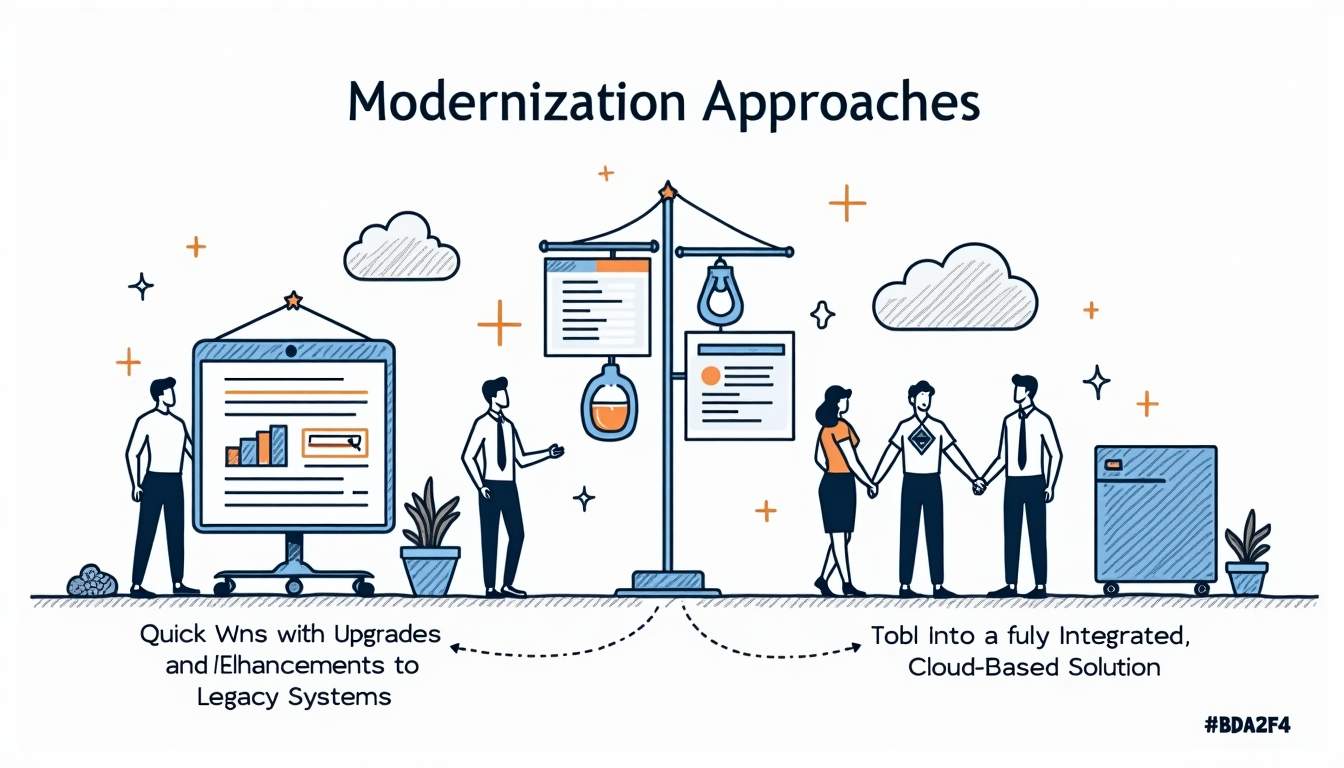
More involved approaches include “replatforming,” where some changes are made to take advantage of managed services or new runtimes, and “refactoring,” where code is restructured to improve maintainability and performance without changing what the system does. At the far end is full “re-architecting” or replacement, where functionality is decomposed into new services, or the system is replaced with a new build or a commercial/SaaS product. The right approach depends on the business value of the system, its technical health, and the organization’s appetite for change and risk.
Effective modernization programs usually combine several of these tactics. A high-risk, low-value application might be retired entirely. A moderately important system might be rehosted and incrementally refactored. A core revenue engine might justify a more ambitious re-architecture alongside a parallel run of the old platform. The key is matching approach to context rather than applying a single pattern everywhere.
How to Build a Practical Modernization Strategy
Effective modernization doesn't happen by accident; it happens through three deliberate phases:
Portfolio Rationalization
A strong modernization strategy starts with a clear view of the application portfolio. That means cataloging key systems, understanding who uses them, what business processes they support, their technical characteristics, and how they interact. From there, applications can be grouped into categories such as “strategic differentiators,” “core but commoditized,” and “candidates for retirement,” alongside an assessment of risk and technical debt.
Outcome-Based Alignment
Next comes aligning modernization work with business outcomes. Instead of a generic goal like “move to the cloud,” it is more effective to tie initiatives to specific results: faster onboarding for new customers, unified data for regulatory reporting, shorter product launch cycles, or improved resilience for a critical revenue line. These outcomes guide priorities and help secure executive sponsorship and funding, because they translate technology decisions into measurable business value.
Product-Mode Execution
Governance and execution models also matter. Many organizations find success with cross-functional product teams that own a domain end to end, rather than project-based teams that disband after delivery. Modernization work can then be planned as part of continuous improvement within those teams, mixing foundational technical changes with visible business features. Clear metrics-such as deployment frequency, incident rates, or time to market-help demonstrate progress and keep the program on track.
Taking the First Step: A Simple Modernization Checklist
Modernization can feel overwhelming when viewed as a multi-year transformation. It becomes more manageable when broken into a concrete first step. One effective approach is to pick a single, business-critical process-such as order management, claims processing, or customer onboarding-and map the systems, data flows, and manual workarounds involved. That map quickly reveals where legacy constraints hurt most and where targeted changes could unlock value.
From there, a practical starting checklist might include: choosing a contained pilot scope with a clear business owner; agreeing success measures such as reduced cycle time or error rates; assessing technical options from rehosting to replacement; planning data migrations and integration changes; and scheduling time for testing, training, and cutover. The point is not to redesign everything at once, but to run a focused, well-governed initiative that builds confidence and templates for the rest of the portfolio.
The pace of change in this space is accelerating. A survey by Infosys found that 50% of legacy applications are slated for modernization within two years, and between 70% and 90% are expected to be modernized within five years, according to its Modernization Radar report. Organizations that start now-methodically, with clear business alignment-will be better positioned to reduce the hidden losses of legacy technology and turn their core systems into platforms for long-term growth.
Getting Help: Partners, Tools, and Teams
Even the most capable internal teams rarely modernize everything alone. Cloud providers, consulting partners, and software vendors all play roles, whether by providing landing zones for modern workloads, tools for code analysis and refactoring, or specialized expertise in areas like mainframe migration or data modernization. The goal is not to outsource strategy, but to selectively bring in capabilities that accelerate progress while building long-term internal strength.
On the internal side, modernization demands a mix of skills: architecture, development, operations, security, data, and change management. It also calls for collaboration between IT and business stakeholders who deeply understand the processes and outcomes built into legacy systems. Successful programs often recognize that modernization is as much about culture and ways of working as it is about technology: adopting practices like continuous delivery, infrastructure as code, and automated testing to ensure that new systems do not become tomorrow’s legacy.
Leadership support is the final ingredient. Modernization can temporarily slow visible feature delivery while foundational work is done, which can be politically challenging. Clear communication about the roadmap, risks, and benefits-backed by regular reporting on both technical and business metrics-helps maintain trust and momentum across the organization.
Unblocking Legacy Systems: How Targeted Execution Drives Real Progress
However, even a small pilot can be difficult to launch if internal teams are bogged down by daily fires or legacy inertia. This is the specific gap designed to be filled by Control. Unlike traditional consulting engagements that begin with theoretical roadmaps, Control focuses on unsticking a single, critical engineering blocker. By deploying a specialized team to solve one hard problem at a fixed price, organizations can move from 'planning mode' to 'delivery mode' in weeks, proving the tangible value of modernization before committing to a massive transformation.