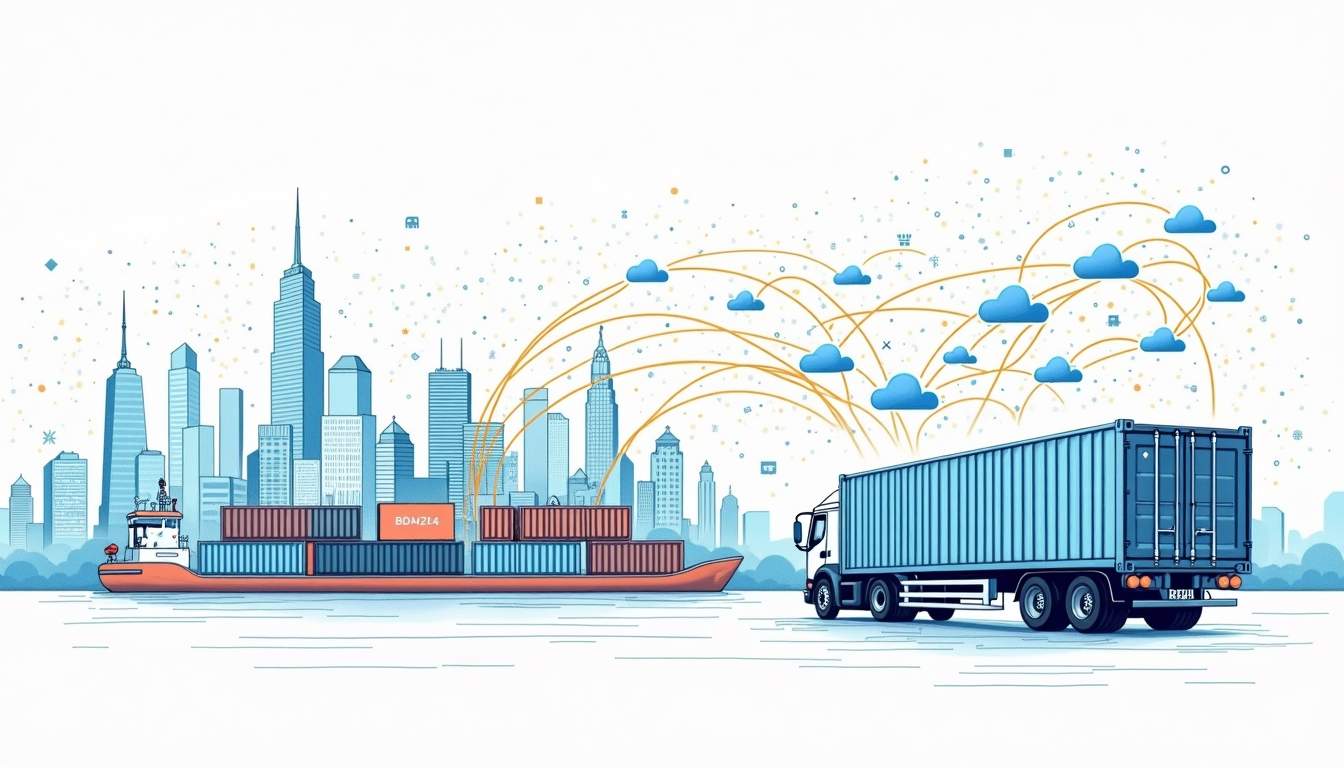

The rapid evolution in application delivery techniques is unmistakably influenced by the rise of containerization. Businesses and developers alike find that deploying applications in isolated environments minimizes friction in updates, scaling, and security.
Distinct innovations in this field continue to reshape how end-to-end solutions are built and maintained, driving the adoption of a technology once confined to niche environments and now fundamental to modern computing.
Recent technological advances (such as AI-powered container optimization), have shown that container management is entering a new era. This progress not only simplifies processes but also encourages efficiency across development life cycles.
In this article, you’ll learn what containerization really means (beyond “packaging apps”) and why it’s become the default model for modern application delivery.
We’ll cover the market forces accelerating adoption, how containers improve consistency, speed, and scalability, and the key security risks teams must manage.
You’ll also get practical best practices and step-by-step guidance for adopting containers in production—plus what’s coming next, from AI-driven optimization to serverless, edge, and hybrid cloud deployments.
So, what containerization really means
At its core, containerization is not just about packaging applications—it’s about redefining how software is built, shipped, and operated across its entire lifecycle.
From a technical standpoint, containerization is the practice of bundling an application together with everything it needs to run—code, runtime, system libraries, and dependencies—into a single, immutable unit called a container. These containers run on a shared operating system kernel but remain logically isolated from one another.
But for IT leaders and founders, what containerization really means goes far beyond the mechanics. We are gonna talk more about them in the next sections, so keep reading!
The rise of containerization and its market impact
Containerization has emerged as a key driver in application deployment and management strategies. The concept of isolating application components in a lightweight, executable package transforms both development and operations.
Modern organizations have realized that separating an application into self-contained modules improves deployment consistency and overall system resilience. This democratization of deployment practices is one of many reasons why containerization is viewed as a cornerstone technology for future-ready infrastructures.

One significant marker of containerization's growing influence is the projected market value for Containers as a Service (CaaS). Expert research suggests that the CaaS market could reach a staggering USD 38.45 billion by 2032, operating at a compound annual growth rate of 29.6% between 2025 and 2032.
Such explosive market growth reflects an increasing reliance on containerization, illustrating its role in scaling modern application architectures.
Containerization's impact reaches far beyond software development. The interconnection between containerized environments and broader economic activities is notable.
As technology spills over into areas such as international trade, containerization has transformed real-world scenarios and logistical efficiencies.
Talking about trading, studies have illustrated dramatic improvements in shipping efficiency, with containerization cutting a ship's average port time from three weeks to just 18 hours ([Matson Research](https://www.nottingham.ac.uk/gep/documents/conferences/2011/korea-conf-november/daniel-bernhofen.pdf)).
How containerization is revolutionizing application delivery
Containerization offers streamlined application delivery, enabling agile software development pipelines and rapid response to market changes. By packaging components together along with their required dependencies, teams can move swiftly from development to deployment without the burdens of heavyweight environments.
This efficiency is particularly crucial in today's dynamic environments where time-to-market is a competitive asset.
A key factor in leveraging containerization lies in its ability to integrate with complementary technologies. The fusion of serverless computing and container technology (serverless container) represents an important milestone, credited with revolutionizing application deployment and bringing forth a new era of flexibility in scaling and operations.
This integration allows enterprises to adopt agile methodologies in delivering cloud-native applications while maintaining the low operational costs associated with containerized deployments.
Containers simplify dependency management by encapsulating all necessary components. This results in consistency between development, testing, and production environments.
It also promotes microservices architectures, where discrete system components evolve independently.
Such modularity is now widely adopted by organizations that require rapid application updates, improved fault isolation, and robust scalability.
Addressing security challenges in containerized environments
While containerization boosts operational efficiency, it also introduces security challenges that have prompted significant industry attention.
Security breaches in container environments can lead to substantial impacts on business operations and data integrity.
Now, you can see the need for robust, multi-layered security strategies in container orchestration and management.
To mitigate vulnerabilities, security frameworks designed explicitly for containerized environments should be adopted. Enhanced isolation techniques, regular vulnerability assessments, and state-of-the-art access controls play pivotal roles in fostering a secure container ecosystem.
Emerging threats and continuously refining security protocols are essential practices in safeguarding containerized workloads.
The adoption of security best practices in both container creation and orchestration is vital because newer methods, such as immutable infrastructure, help reduce the risk of exploitation.
With the industry's evolving threat landscape, organizations must remain vigilant, integrating both automated and manual assertive measures to ensure that their containerized applications are well-protected.
Benefits of aligning containerization with business objectives
For businesses, the integration of containerization is more than a technical upgrade-it aligns closely with strategic business objectives such as agility, cost efficiency, and scalability.
Adopting containerized workflows enables IT departments to better support business goals in unstructured markets where rapid adaptation is critical.
Investment in containerization yields dividends on many fronts, from driving faster development cycles to optimizing resource allocation, all of which contribute to stronger competitive advantages.
The adoption in production environments, where over 60% of organizations reported using containers as of 2023.
The direct alignment between container technology and business success is visible in how organizations manage their digital assets. Benefits such as reduced operational downtime, faster deployment times, and improved system resilience resonate strongly with business leaders aiming for a cultural transformation.
As competitive pressures intensify, the pressure to innovate using containerization techniques will only grow stronger.
Best practices to adopt containerization in your business
With an ever-expanding array of tools and frameworks supporting containerization, best practices have gradually crystallized.
One common recommendation involves establishing clear protocols for container creation, deployment, and ongoing monitoring.
Adopting automation tools that support continuous integration and continuous deployment (CI/CD) pipelines can significantly reduce manual errors. As containerized environments proliferate, these best practices serve as essential guidelines for scalable operations.
Security, performance, and operational sustainability remain key focus areas for teams leveraging containerization. Detailed strategies must include secure Bootstrapping, detailed logging and monitoring systems, and regular audits to ensure containers stay compliant with evolving regulatory and organizational policies.
Adopting such standardization not only streamlines management but also helps mitigate risks associated with misconfigured environments.
Collaborative ecosystems have also emerged, with various communities and industry groups sharing innovative strategies and practical solutions based on real experience.
Our recommendation is to team up with a software development company that helps you integrate and modernize your stack (like Wednesday and our Control service)
This culture of shared knowledge encourages continuous improvement and collaborative problem-solving, which in turn propels containerization technologies to better meet the evolving needs of the industry.
Practical steps for embracing containerization
Organizations looking to harness the power of containerization can take several practical steps for a successful transition.
- An initial assessment of existing workflows and system dependencies is important to identify where containerization can have the most impact. This evaluation should be coupled with training initiatives for development and operations teams to ensure they fully understand the container ecosystem.
- Investing in modern container orchestration platforms and adopting practices that emphasize modular design can help organizations avoid common pitfalls. Automated monitoring, scaling, and security reviews add layers of robustness to containerized applications, ensuring that new deployments integrate seamlessly into existing infrastructures.
- Ultimately, it is crucial to align technical implementations with broader business strategies. This means reassessing infrastructure budgets, rearranging IT team structures, and incorporating feedback loops to continuously evolve container-based solutions.
- Through systematic planning and incremental adoption, organizations often find that the benefits (faster deployment cycles, improved resilience, and significant cost efficiencies) far outweigh the initial challenges associated with the transition.
The road ahead for container-based technologies
Looking forward, containerization is expected to remain a central pillar of modern digital architectures.
With upcoming innovations in AI, enhanced security protocols, and ever more sophisticated orchestration frameworks, the container ecosystem is poised to evolve significantly in the coming years.
The potential for further integration of containerization with trends such as edge computing and hybrid cloud strategies promises new levels of performance and flexibility for application delivery.
As organizations continue to innovate, the adoption of container-centric approaches will likely accelerate, influenced by both technological imperatives and competitive business dynamics.
The ongoing growth and evolution of this space signal that containerization is not just a temporary trend. It is more a long-term foundation on which the future of application development and delivery is built.
By embracing the transformational nature of container technology, businesses can position themselves to capitalize on future opportunities while maintaining a competitive edge.
Our final thoughts: building a future-proof infrastructure
The journey from traditional monolithic deployments to container-based architectures is emblematic of the broader digital transformation sweeping across all industries.
With proven market growth, technological integration with AI and serverless computing, and an expanding user base in the Docker ecosystem, containerization stands as a resilient foundation for modern application delivery.
Security remains a complex challenge, yet it drives continuous innovation and more robust practices across the board. As containerization embeds itself deeper into both digital and physical infrastructures, the advantages are clear: faster deployments, enhanced scalability, and alignment with evolving global economic trends.
Organizations that adopt containerization not only embrace state-of-the-art technologies but also lay a solid groundwork for future developments. The agility and efficiency shown by containerized systems ensure that businesses remain competitive in a rapidly changing digital environment.
This shift toward automation, integrated security, and advanced resource optimization is not just about making processes faster-it is about building a future-proof infrastructure that can adapt to whatever innovations come next.