Product · US personal finance startup
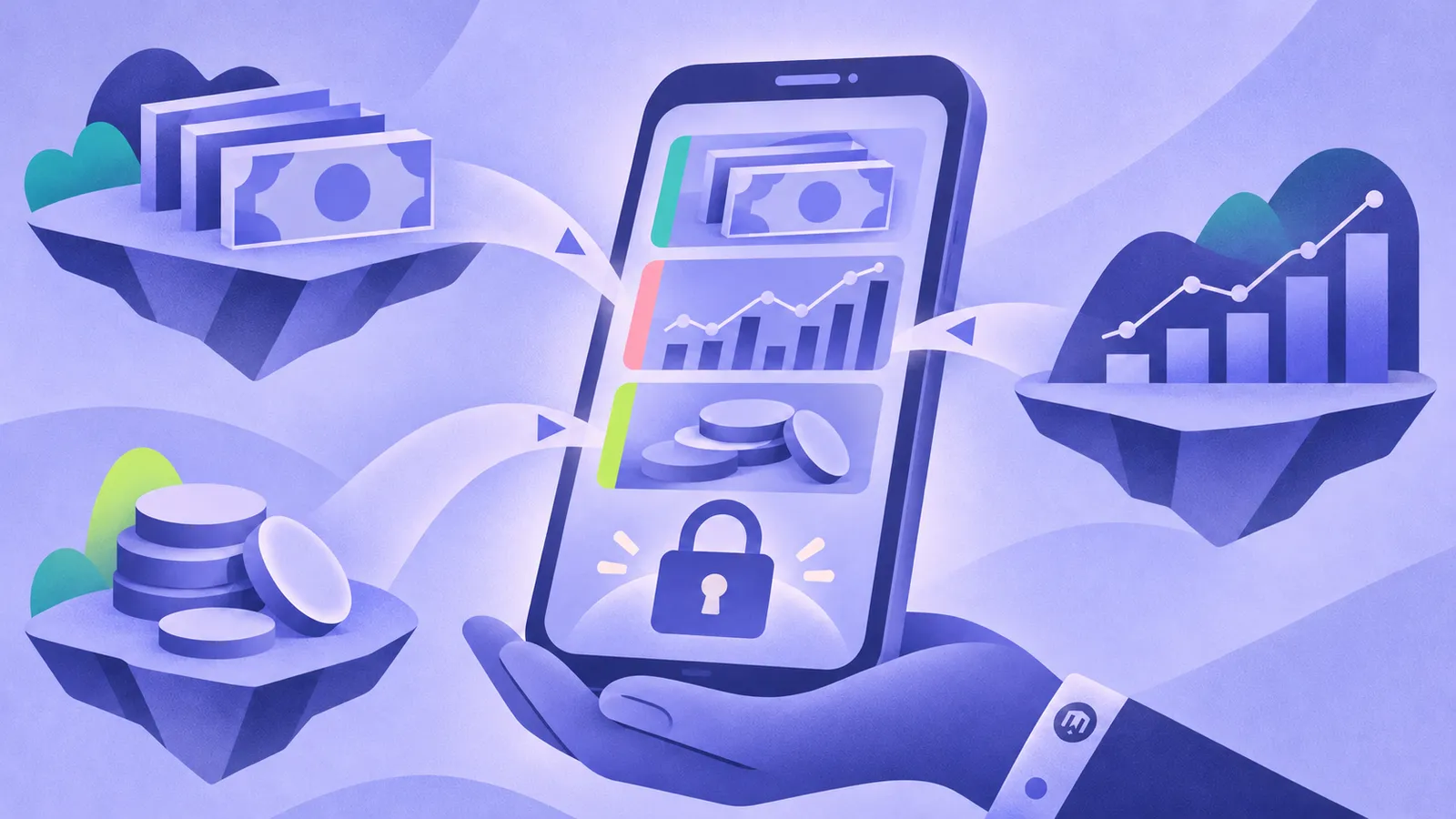
iOS financial dashboard with bank-grade security shipped from scratch. Banks, ETFs, and crypto in one view.
The client needed every financial account in one place. Wednesday built the iOS app and the backend, wired up identity verification, encrypted every API call, and cleared a full penetration test before launch.

Connecting five financial institutions is not a weekend project
The client wanted one place to see every financial account: checking, savings, investment accounts, ETFs, brokerage positions, and a crypto wallet. For a user with accounts at three banks and a Coinbase account, that meant pulling live data from five separate systems, each with different APIs, different authentication requirements, and different data formats.
The user experience had to be simple. The infrastructure had to meet financial-grade security standards. The product expected significant scale, so the backend had to handle high traffic without requiring expensive manual intervention as users grew.
Four problems defined the project. First, data aggregation at scale. Second, identity verification: users linking financial accounts needed to prove they were who they claimed to be, matched against a government ID. Third, security: all API traffic needed encryption, and the full application needed to pass a penetration test before any real user data was processed. Fourth, authentication: the product needed to support email OTP, phone OTP, Google, Apple, and Facebook sign-in, plus biometric login with Face ID and Touch ID, in any combination.
A custom identity verification flow was also needed. The name on a user's government ID frequently differs from the name on file at the financial institution. Exact-match logic would reject legitimate users at an unacceptable rate.
“We needed to build to financial-grade security standards from day one. Retrofitting security after launch is not a real option in this space.”
Founder — Personal finance platform
Every account connected. Every API encrypted. Pen test cleared.
Wednesday built the iOS app and the backend infrastructure together as one team.
Data aggregation. Plaid was used to pull bank and brokerage account data. The Coinbase API handled crypto account balances and transfers. Account data from all sources was normalized into a single financial view per user. Investment patterns were surfaced through data analysis across the aggregated accounts.
Authentication. AWS Cognito handled user management. Lambda triggers supported all five sign-in methods: email OTP, phone OTP, Google, Apple, and Facebook. Face ID and Touch ID were integrated for biometric login. Users can mix and match authentication methods.
Identity verification. Onfido matched user-submitted government IDs against the photo and name on the document. A custom fuzzy matching algorithm resolved name discrepancies between the government ID and the financial institution record. A user registered as "William" at their bank but "Bill" on their license passes verification. Exact-match logic would have rejected them.
Fund transfers. A unified transfer interface was built on top of Dwolla and Plaid for bank-to-bank moves and the Coinbase API for crypto transfers. From the user's perspective it is one transfer screen, regardless of which account types are involved.
Security. All API traffic was encrypted with AES-256. Sensitive data in transit was fully encrypted at every point. The team ran a penetration test before any user data was processed. No findings required remediation at launch.
Scale. The backend used a managed DynamoDB cluster with AWS AppSync and Lambda data sources. API results were cached to reduce latency. The architecture handles high traffic without degrading and without requiring manual scaling steps as the user base grows.
“Their skill level and commitment are impressive. The code was high quality, well structured, and delivered on time.”
Senior Engineering Manager — Financial services company
All accounts connected. APIs encrypted. Pen test cleared.
The platform launched with bank, brokerage, and crypto accounts connected in a single view. Users see all balances and all recent transactions from one screen. Transfers between any linked account go through one interface.
Every API call is encrypted with AES-256. Sensitive data in transit is fully protected. The penetration test cleared at launch with no findings requiring remediation before the product went live.
Face ID, Touch ID, and all five sign-in methods work in any combination. Users pick their preferred authentication method.
The backend scales under load without manual intervention. As the user base grows, the infrastructure cost per user stays flat.
“I'm impressed with the depth of knowledge that Wednesday's developers bring. It's more than what other vendors provided. Their engineers are experienced and qualified for the job.”
Head of Digital Technology — Financial services organization
Why it paid off
AES-256 encryption, identity verification, and a penetration test before launch were not optional features. Retrofitting those controls after users link real financial accounts costs significantly more than building them in from the start, and carries regulatory exposure.
What you get · Product
What this means for you
An early-stage team shipped a bank-grade app from scratch. Your product can go from idea to store with a small team and our agents doing the heavy lifting.